Subfloor microclimates across historic Atlanta neighborhoods dictate pest severity. In 1920s Craftsman bungalows throughout Grant Park, Kirkwood, and Inman Park, open brick-pier foundations draw ambient summer humidity…
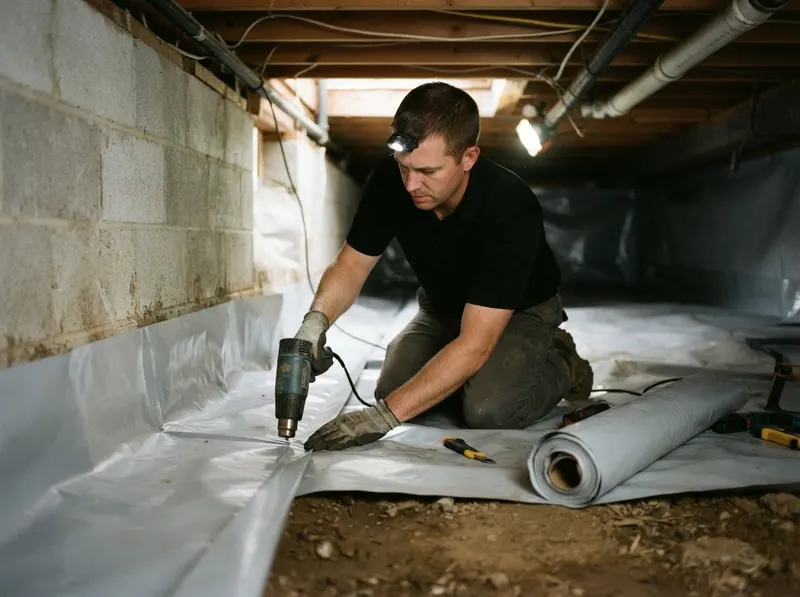
Subfloor microclimates across historic Atlanta neighborhoods dictate pest severity. In 1920s Craftsman bungalows throughout Grant Park, Kirkwood, and Inman Park, open brick-pier foundations draw ambient summer humidity above 80%, softening southern yellow pine joists. Subterranean termites (Reticulitermes flavipes) and smokybrown cockroaches require wood moisture contents above 17% to sustain colonies. A crawlspace encapsulation pest barrier transforms open-vent earthen voids into conditioned, sealed building envelopes. By mechanical fastening of heavy, fiber-reinforced liners up foundation walls and sealing rim joists with class-one fire-rated expanding foam, the system removes the subterranean moisture path that attracts vectors into living quarters overhead.
Structural exclusion works where repeated chemical applications fail. Conventional broad-spectrum liquid insecticides degrade rapidly in damp soil, requiring monthly applications that deposit chemical residues near household ductwork. Encapsulation directly resolves the environmental vulnerability. Homes in Virginia-Highland, Midtown, and Ansley Park featuring dense tree canopies and Piedmont clay soils often experience high groundwater wicking. If an earthen crawlspace shows relative humidity over 60%, subterranean wood decay and rodent burrowing are inevitable. In these environments, mechanical barrier installation is selected over routine perimeter spraying because it eliminates harborage permanently; the trade-off is an upfront capital installation rather than lower, recurrent treatment fees.
The installation sequence follows rigid building physics. Step 1: Technicians remove biological debris, wood offcuts, and decaying organic matter from the crawlspace floor. Step 2: Foundation soil is leveled, and masonry piers are wrapped. Step 3: A 20-mil cross-laminated liner is rolled across the floor, overlapped by 12 inches at seams, and sealed with structural polyurethane adhesive. Step 4: Technicians fasten the barrier directly to foundation walls three inches below the mudsill, leaving a critical inspection gap for termite detection required by Georgia building codes. Step 5: Foundation vents are sealed from the interior using closed-cell composite panels, and an energy-efficient crawlspace dehumidifier is calibrated to maintain subfloor humidity at an invariant 50%.
Properties bordering urban riparian corridors, such as historic masonry row homes near Cabbagetown or shaded estates in Buckhead and West End, often present complex access restrictions. Crawlspaces with less than 24 inches of vertical clearance require specialized low-profile soil grading before continuous membrane placement. Where foundation footings rest on exposed granite bedrock, common along the ridge through Old Fourth Ward, liners must be bonded with specialized elastomeric mastics rather than mechanical drive pins. The encapsulation eliminates the damp, musty odor moving through floorboard gaps and stops rodents from utilizing subfloor fiberglass batt insulation as nesting substrate.
Every job gets a firm, written price after a free on-site visit.
Tell us about your crawlspace encapsulation pest barrier job in Atlanta and we'll send a clear, written quote, usually the same day.
 Brass Lantern Pest Control